
Bulk mushroom ingredients · Molai
Mushroom Extracts,Powders & Blends
Hangzhou Molai Biotech Co., Ltd. supplies mushroom ingredients for supplement, food and beverage formulation. Compare extracts, milled powders and blends by species, composition and processing route, then review the specification and batch testing documents for your selected ingredient.
01Ingredient catalogue
02Format comparison
03Process and testing
Product index
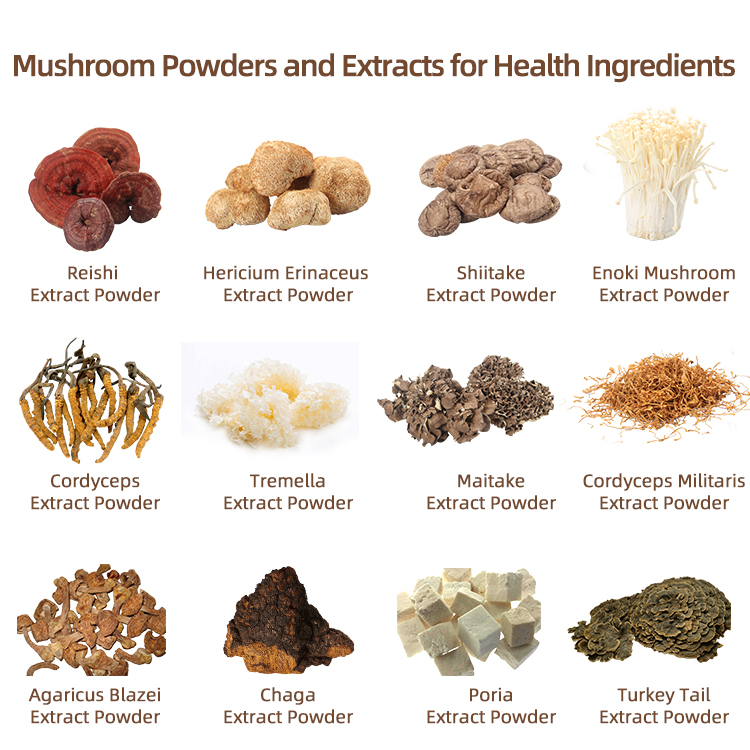
Find Your Mushroom Ingredient
Start with the mushroom species and format. Each product review should identify the scientific name, material used, extraction or milling process, and full composition, including any carrier or other blend ingredients. These details define what you are buying before you compare a quoted content percentage.
The process charts below describe fruiting-body extraction. Check the selected product record for its actual source material; one process chart does not establish the composition of every catalogue item.
Format comparison
Extract, Powder or Blend: What Changes?
An extract is obtained through extraction and further processing; a milled mushroom powder is prepared by grinding the material; a blend combines specified ingredients. An extract can also be supplied as a powder, so the word “powder” alone does not identify how an ingredient was made.
An extraction ratio describes a material-to-extract relationship, not a measured beta-glucan percentage. Ask how the ratio is calculated and compare composition using the same test method, units and reporting basis.
| Ingredient format | Identity and processing | Documents to compare | Formulation checks |
|---|---|---|---|
| Mushroom extracts | Confirm species, source material, hot-water or dual-extraction route, and any carriers. Separate the extraction ratio from measured marker content. | Product specification, process description, marker assay and batch Certificate of Analysis (COA). Check whether values are reported on a dry or as-supplied basis. | Evaluate dispersibility, sediment, flavour and behaviour under your processing conditions. For capsules, check powder flow and fill weight with a sample. |
| Mushroom powders | Confirm whether the product is milled mushroom material or a dried extract. For milled material, check the species, part used, drying route and particle size. | Identity and composition record, physical specification and batch COA, plus packaging, storage and shelf-life information for that product. | Assess texture, colour and mushroom flavour in the finished recipe. Finer particle size alone does not demonstrate solubility or extract concentration. |
| Mushroom blends | Identify each mushroom, whether it enters as an extract or milled powder, its agreed proportion, and any carriers or other ingredients. | Formula version, component specifications, finished-blend specification and corresponding batch results. A component COA describes that input, not the finished blend. | Confirm ingredient amounts per serving, flavour balance and mixing performance. Evaluate the complete blend in the intended food, beverage or supplement format. |
Manufacturing process
From Cultivation to Mushroom Extraction
Molai’s process charts describe three workflows: raw-material cultivation and acceptance, hot-water extraction, and dual extraction with ethanol and water. Cultivation supplies the accepted raw material; the two extraction routes then follow different processing steps.
The hot-water route also includes ethanol precipitation after concentration. Dual extraction starts with an ethanol extraction and later combines that fraction with the water-derived fraction. Confirm the route for your selected product.
- 01 / SCREEN
Screen cultivation inputs
Test cultivation raw materials for pesticide residues and heavy metals. The process excludes inputs that fail the acceptance check.
- 02 / CULTIVATE
Manage growing conditions
Follow planting-base controls for water resources, pesticide residues and heavy metals in the surrounding cultivation environment.
- 03 / HARVEST
Harvest the mushrooms
Harvest the cultivated mushrooms and transfer the harvested material to drying, as shown in the raw-material workflow.
- 04 / DRY & TEST
Check dried material
Dry the harvested mushrooms, then test the dried material. A failed result leads to rejection before warehouse acceptance.
- 05 / ACCEPT
Store accepted material
Move accepted dried material into the raw-material warehouse. The extraction routes begin with stored material, followed by selection, crushing and sieving.
- 01 / PREPARE
Select fruiting bodies
Select stored mushroom fruiting bodies, remove unsuitable pieces and residual growing medium, then crush and sieve before prepared-material storage.
- 02 / WATER
Extract twice with water
Decoct the prepared material twice using purified water. Filter the liquid to separate the water extract from insoluble mushroom material.
- 03 / CONCENTRATE
Concentrate under vacuum
Collect the filtrate and concentrate it under vacuum. The chart specifies a concentration temperature below 75°C for this route.
- 04 / PRECIPITATE
Collect the precipitate
Add food-grade ethanol, shown as 95% in the flow chart, for precipitation. Separate impurities, collect the precipitate and recover ethanol.
- 05 / DRY
Prepare extract powder
Add purified water and dissolve the collected material at 90°C before spray drying. Collect the powder in the designated clean area and transfer it to storage.
- 01 / ETHANOL
Extract prepared material
Select, crush and sieve stored raw material. Extract with 70% food-grade ethanol, then filter to separate the liquid and solid fractions.
- 02 / SEPARATE
Retain both fractions
Collect the alcohol-extract liquid and recover ethanol. Keep the separated mushroom solids for the following water-extraction stage.
- 03 / WATER
Process the retained solids
Decoct the solids twice with purified water, filter and concentrate under vacuum below 75°C. Precipitate with 95% food-grade ethanol and recover ethanol.
- 04 / COMBINE
Combine and spray dry
Redissolve the collected precipitate with purified water and combine it with the alcohol-extract fraction. The chart specifies dissolution at 90°C before spray drying.
- 05 / FINISH
Mix, sieve, pack and test
Collect the dried powder, mix, sieve and pack, then test the finished product. Store accepted and nonconforming products separately, as the finishing chart specifies.
Quality testing
Five Steps from Identity to Batch Approval
Build a product review in five stages: establish what the ingredient is, verify its measured composition, assess its physical properties, review microbiology and contaminants, then reconcile the evidence for batch approval. Each stage adds information needed for the next decision.
Use the document fields below as a review guide. A specification sets acceptance criteria; a laboratory report records sample results; a COA summarises the results reported for an identified batch. Confirm the available files, laboratory, test scope and frequency for your selected product.
-
01
Establish identity: raw-material records
Files to review:Raw-material acceptance record and product specification. Check the common and scientific names, material used, supplier or source, raw-material lot, receiving date, identity-check method and acceptance decision. The composition record should identify any carriers or other ingredients.
What this establishes:The identity and composition to which later results must relate. A species name alone does not establish whether the product uses fruiting bodies, mycelium or another specified material.
-
02
Verify composition: marker assay report
File to review:The assay report for the specified marker, such as beta-glucans or triterpenes where applicable. Check sample and batch identifiers, analyte, method and version, result, unit, dry or as-supplied basis, acceptance limit, laboratory and test date.
What this adds:A measured result beyond ingredient identity. For example, theMegazyme yeast and mushroom assaydetermines beta-glucan indirectly from total and alpha-glucan measurements. Confirm the method actually used on your report.
-
03
Assess usability: physical test record
Files to review:Physical and physicochemical test records. Check appearance and colour, moisture or loss on drying, ash, and particle-size results where specified. Each result needs its method, unit, acceptance criterion and sample or batch reference. For sieving, read the mesh or aperture together with the percentage passing.
What this adds:Evidence for handling and formulation decisions. Compare these results with your blending, filling or beverage requirements, then assess a sample under your own processing conditions.
-
04
Review contaminants: laboratory reports
Files to review:Microbiology, heavy-metal and pesticide-residue reports. Check the named organisms or analytes, methods, results, units, limits, laboratory, report date and matching batch. Review the actual pesticide panel and detection or quantification limits; confirm whether residual-solvent testing is required for the selected extraction route.
What this adds:Results for the hazards covered by the test scope. “Not detected” must be read with the stated method limit. An unlisted analyte has no reported result in that document.
-
05
Approve the batch: COA and release record
Files to review:Batch Certificate of Analysis (COA) and release record. Check the product name, batch number, specification reference, reported tests, results, units and limits, issue date and authorised approval. Reconcile these with the supporting reports and the manufacturing, shelf-life, storage and packaging information supplied for that batch.
What this completes:A documented decision against the agreed specification. Resolve missing, conflicting or out-of-specification results before purchasing approval; a generic specification or an earlier batch’s COA cannot verify the batch under review.
Product requirements
Send Product Requirements
Request a Sample, Specification or Batch COA
Send the mushroom species, extract or powder format, intended application, target specification, quantity and destination market. For document requests, include the product name and batch number if available. Specify any required test methods so our team can confirm the relevant sample and documentation options.
 Privacy settings